MY WORK AT RADIO RSA - COLIN MILLER (Guest Contributor)

MY WORK AT RADIO RSA
by COLIN MILLER (Guest Contributor)

My office was located not at Broadcasting Centre in Auckland Park, but at the SABC’s Receiving Station at Panorama, near Honeydew, northwest of Johannesburg in a peaceful country setting away from the hustle and bustle of the city. The site was only used daily from 6:00 a.m. to 10:00 p.m. to monitor news broadcasts from various international stations such as BBC and Voice of America, and feed them by landline to the News Department in Auckland Park. They also monitored enemy broadcasts at that time. The site had several rhombics, verticals and an impressive log periodic antenna. Several Rohde & Schwarz EK-070 receivers were used for the news feeds, while Racal RA17s were used for band scans. These scans were exchanged for scans from other monitoring stations. Regular staff worked from 7:00 a.m. to 4:00 p.m.
Sadly, now all the short wave receivers and antennas have gone, and the site is now used by Sentech, a provider of broadband communications. The site is no longer out in the country, but now in a built-up residential area.
I also assisted in the frequency planning of the station. Since the 1950s I had been a DXer and therefore had an intimate knowledge of what was happening on the short wave bands, which stations were on, and when. This knowledge helped in deciding which frequency should be used to a particular target area, as we had to change some of the frequencies a few times a year. Unlike AM or FM, short wave reception depends on time of day, season and the sunspot cycle. Transmissions typically lasted for an hour in the various language services, exceptions being for English and some African languages to neighbouring countries. During the high end of the sunspot cycle, 25790 kHz was heard well in Europe using a north south path.
Our department produced a monitors’ handbook, which included what was required in monitoring the broadcasts, how to use the reception report forms, the SIFO code and so on. It also had pictures of the antennas and transmitters. We also sent out a bi-monthly newsletter in English, which had to be sent to Auckland Park to be translated into French, Dutch, German, Portuguese and Spanish.


It then had to go to the printing department and then mailed out. The newsletter included some current news about the station and its personalities, some aspect of South African culture, birthday greetings, and a contest in which we gave away various promotional items such as key rings, paper knives and other items to members. In addition, we sent out a supply of reception report forms for Panel members to complete and return to us for analysis.

Another incentive in sending reception reports was to issue a certificate and adhesive stickers after every ten reports had been received from a member. When all the spaces for the stickers were full, an Honorary Certificate was issued.

Times have certainly changed since then. Little did we know that within a few decades it would be possible to use remote receivers via the Internet to hear “live” what the signal was like in the target area, instead of having to wait a few weeks for the result!
It is customary for stations to issue QSL cards, i.e. post cards confirming that the listener heard a particular broadcast. Radio RSA had a whole series of these very colourful cards, which depicted the flora, fauna, and scenic spots of South Africa. They were highly sought by DXers. I was the verie signer for panel members.

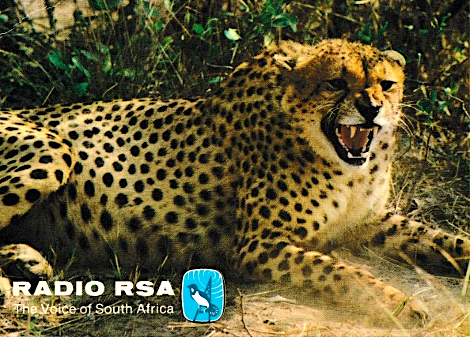

I also issued QSLs in response to reception reports from DXers for the domestic services such as Radio 5, Radio Orion etc. Sometimes we would receive a tape of our broadcasts, which would be returned with some South African music.
Naturally, I got to meet some of the announcers at Radio RSA whenever I went to Auckland Park. I remember meeting Bernard Lehmann, who used to work at the Swiss Shortwave Service, and also Henry Vaughan, who was with Lourenço Marques Radio in Mozambique at one time. Others who come to mind and later joined the television service include Dorianne Berry, first female announcer on SABC TV, and TV newsreaders Shirley Veal, David Hall-Green and Colin Houston.

 |
| In this photo, Shirley is on the left, Kathy on the rignt. |
Although I was not one of the regular announcers, my boss Pieter Martins hosted a weekly show especially for shortwave enthusiasts, called DX Corner. I sometimes went with him to Auckland Park to co-host the program. Then every year on New Year’s Eve, Radio RSA produced a special international call-in show from midnight to dawn, and I would join some of the announcers, and was able to talk to some of our Panel members by phone. At that time, it was rather expensive to make an international call so it was a big sacrifice made by the listeners. I even got to meet some of them when they were visiting South Africa.
I consider my time at Radio RSA to be the best job I ever had, because I was able to combine my hobby with my job, a dream everybody has.
Colin Miller

Thank you so much, Colin, for taking us on this South African trip down memory lane. Here in Australia, Radio RSA was well-heard across the shortwave spectrum and I have many RSA QSL cards in my collection. I remember the station had a great signal into Melbourne on the 11 metre band during the peaks of the sunspot cycle - 25730 and 25790 kHz during cycle 21 in 1979 and cycle 22 in 1989. During those times of high sunspots, Radio RSA would cruise in to Melbourne with such a big signal and none of the noise that we hear on the lower frequencies, providing hours of very pleasant listening.
73 and good DX to you all,
Rob Wagner VK3BVW


CLICK HERE for VK3BVW Live Stream (Clublog)

| QRZ callsign lookup: |
© Rob Wagner, Mount Evelyn DX Report, and contributors 2012-2022


Comments
Post a Comment
Comments are moderated and may not appear immediately. If your comment isn’t visible right away, it has been received and will be published shortly.