STRONG SIGNAL, NO DECODES: Auroral Flutter and the Bouvet-Australia FT8 Puzzle

Strong Signals, No Decodes:
Auroral Flutter and the Bouvet–Australia FT8 Puzzle
When the 3Y0K DXpedition to Bouvet Island went on the air, many amateur radio operators across eastern Australia eagerly sought a contact. Bouvet is one of the rarest DX entities on Earth, and any activation naturally sparks strong interest on the HF bands.
Yet something unusual happened. Some Australian operators reported seeing Bouvet signals clearly on their FT8 waterfalls. In some cases, the signals appeared reasonably strong. However, despite this, decodes were rare or nonexistent.
That was the case at my QTH. This isn't a beams-and-high-power setup. My modest operation involves 50 W into an 80m long horizontal skyloop or a 30m vertical delta loop. I saw the 3Y0K signal numerous times, but there was only one decode. Talk about frustrating!
This was quite baffling. After all, FT8 is known for its ability to decode signals well below the noise floor. If the signal was visible, why wasn't it decoding? So, I took some time (and a lot of reading) to investigate what might be going on.
One possible explanation lies in a phenomenon well known to radio scientists but less familiar to some HF operators: auroral flutter.
Bouvet and the Southern High-Latitude Path
Bouvet Island is situated in the remote South Atlantic at approximately 54° south latitude (−54.4333, 3.400, to be exact), placing it firmly within the sub-Antarctic region. From eastern Australia, the great-circle radio path to Bouvet curves deep into the southern high latitudes before turning northward toward the Australian continent.
This geometry matters.
Unlike many DX paths that stay within the relatively stable mid-latitude ionosphere, the Bouvet–Australia route travels near the southern auroral zone. In this region, Earth's upper atmosphere is often disturbed by energetic particles from the solar wind.
During geomagnetic activity, these particles enter the atmosphere along Earth's magnetic field lines, producing the aurora. At the same time, they create complex structures of enhanced ionisation in the ionosphere. For radio signals travelling through this region, the ionosphere can be anything but smooth.
The Auroral Oval
Auroral activity takes place within a ring-shaped area around the geomagnetic poles called the auroral oval. Under quiet conditions, the oval generally sits near 65–70° geomagnetic latitude, but during geomagnetic disturbances, it expands towards lower latitudes.
Signals travelling near this region can encounter a highly irregular ionosphere filled with drifting filaments and patches of ionised plasma. These structures are aligned with Earth's magnetic field and can move through the ionosphere at hundreds of metres per second.
From a radio propagation perspective, this environment behaves quite differently from the stable F-layer reflections that support most long-distance HF communication.
 |
| Illustrations of where the Auroral Oval zones occur in the northern and southern hemispheres. (Image courtesy of William Copeland) |
When the Ionosphere Becomes Turbulent
In mid-latitude propagation, the ionosphere often acts like a relatively smooth mirror, reflecting HF signals back toward Earth.
In the auroral zone, that mirror breaks down.
Instead of reflecting cleanly from a stable layer, radio waves are scattered by many small ionised structures. Each of these acts like a tiny moving reflector, sending part of the signal along slightly different paths.
When those dispersed components arrive at the receiver, they merge in intricate ways. The outcome can include:
• rapid fading
• multiple propagation paths
• unstable phase relationships
• small but significant frequency shifts
These effects collectively are known as auroral flutter.
Operators listening to CW signals during auroral conditions often describe the sound as rough, raspy, or "buzzing." The signal strength may stay surprisingly good, but the tone becomes unstable.
The Role of Doppler Spread
One of the key effects of auroral scattering is Doppler spreading. Since the plasma structures causing scattering are moving through the ionosphere, each scattered signal component undergoes a slightly different Doppler shift. Rather than arriving at a single frequency, the signal energy is spread across a small frequency range.
In high-latitude propagation studies, Doppler spreads under auroral conditions have been observed to range from a few hertz to several tens of Hertz, and occasionally much higher during strong disturbances.
For many modes of communication, this distortion is inconvenient but manageable. However, for FT8, it can be deadly.
Why FT8 Is Especially Sensitive
FT8 transmits a series of eight audio tones spaced just 6.25 Hz apart. The receiving software integrates the signal over a 12.6-second transmission window and works out which tones appeared at each symbol interval. For this process to function properly, the received tones must stay very stable in both frequency and phase.
Auroral flutter disrupts exactly those properties.
If Doppler spreading widens the signal spectrum by tens of Hertz, the narrow FT8 tones blend together. The decoder can no longer identify which tone matches which symbol. The signal might still be clearly visible on the waterfall display, but the information it carries becomes impossible to decode.
In other words, the issue isn't signal strength. It is a loss of spectral coherence.
 |
| This great circle map is centred on Bouvet Island. The distance between Bouvet and southeastern Australia isn't that great. To my QTH, it's only 9162 km (5693 mi). But, for me, it proved to be tough going trying to get a decode from the DXpedition team! The further west we go across Australia, the less influence the auroral zone has - the VK6 guys in Perth were probably in a better location for Bouvet. |
The Geometry of the Bouvet–Australia Path
Examining the great-circle path between Bouvet Island and eastern Australia clarifies why auroral effects might have been particularly noticeable on this route.
HF signals generally follow the great-circle route, the shortest way between two points on the Earth's surface. When this route is plotted on a globe instead of a flat map, it becomes clear that the Bouvet–Australia path dips deep into the southern high latitudes.
As mentioned previously, Bouvet itself lies near 54° south latitude, already well into the sub-Antarctic. From there, the great-circle route toward eastern Australia initially runs southeast across the Southern Ocean before turning northward toward the Australian continent.
For many stations along Australia's east coast, the route reaches around 60–65° south latitude before heading north again. This is particularly true for amateurs in southern Victoria and Tasmania. Those latitudes lie close to the edge of the southern auroral zone.
Another key detail is that auroral activity is organised by geomagnetic latitude rather than geographic latitude. Because the geomagnetic poles are offset from the geographic poles, a radio path passing through geographic latitudes near 60°S might actually traverse geomagnetic latitudes associated with the auroral oval.
During periods of moderate geomagnetic activity, the auroral zone can expand towards lower latitudes. When this occurs, parts of the Bouvet–Australia route may be within or just beside the disturbed auroral ionosphere.
In other words, the signal might spend a significant part of its journey passing through a region of highly turbulent ionosphere, a situation that can easily cause auroral flutter and Doppler spreading.
A Long Encounter with the Auroral Zone
The severity of auroral flutter partly depends on how long the signal interacts with the disturbed region.
If a propagation path briefly crosses the auroral oval, the resulting distortion may be limited. However, if the path runs along the edge of the oval for thousands of kilometres, the signal can accumulate significant phase and frequency distortion.
The Bouvet–Australia geometry seems to do exactly that. Instead of crossing the auroral zone quickly, the route might follow the southern high-latitude belt for quite a distance. In propagation terms, this makes it more similar to a sub-polar path than a typical mid-latitude DX route.
 |
| Another look at the great circle path, this time on a "flat map". This version was calculated for my QTH at Mount Evelyn, Victoria, for March 1, 2026, at 0900 UTC |
Strong Signals but No Decodes
This situation offers a plausible explanation for reports from eastern Australian operators. Signals from Bouvet might have travelled through a region of turbulent ionosphere where scattering and Doppler spreading disrupted the narrow spectral stability required for FT8 decoding.
Because auroral scattering redistributes signal energy rather than removing it, the signal can still look visible, sometimes even strong, on a waterfall display. But the spectral precision needed for the digital decoder has been lost.
Not the Only Possible Factor
It is important to note that auroral flutter is not the only phenomenon that can disrupt high-latitude HF propagation. Other effects, such as polar absorption, travelling ionospheric disturbances, or spread-F conditions, can also impair signals.
Without detailed measurements, such as Doppler spectra, ionosonde data, or geomagnetic records, it is hard to pinpoint which mechanism was dominant during the Bouvet operation.
Nevertheless, the combination of high-latitude path geometry, auroral ionospheric turbulence, and FT8's extremely narrow tone spacing makes auroral flutter a compelling explanation.
A Reminder from the Ionosphere
The Bouvet activation served as a useful reminder that modern digital modes, impressive as they are, still rely on the behaviour of Earth's ionosphere.
FT8 can decode signals buried deep in the noise, but it assumes those signals stay spectrally stable. When the ionosphere becomes turbulent, as it often does near the auroral zones, that assumption can break down.
The result is the curious scenario some Australian operators faced: a signal clearly visible on the waterfall, yet stubbornly refusing to decode.
Sometimes the difficulty in radio communication isn't hearing the signal at all. Sometimes the challenge is hearing it over the turbulence.
References
Davies, K. Ionospheric Radio.
Copeland, W. What are the Northern Lights?
Hunsucker, R. D., & Hargreaves, J. K. The High-Latitude Ionosphere and its Effects on Radio Propagation.
Ratcliffe, J. A. An Introduction to the Ionosphere and Magnetosphere.
ARRL. The ARRL Handbook for Radio Communications.
Space Weather Services (Bureau of Meteorology), auroral and geomagnetic resources.
73 and wishing you the best of DX!
Rob Wagner VK3BVW



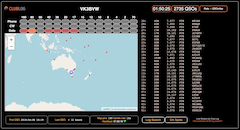
CLICK HERE for VK3BVW Live Stream (Clublog)
| QRZ callsign lookup: |
© Rob Wagner, Mount Evelyn DX Report, and contributors 2012-2026


Great article, Robert!
ReplyDeleteCheers, Luke.
DeleteInteresting, I had this a few times on 6m FT8 with D2A. Others in my area had the same issue. Might be something else like auroral flutter, as this was at the end of the ES season. No polar path involved. 73, Bas
ReplyDeleteThanks for the comment, Bas. 73 de Rob VK3BVW
Delete