SHORTWAVE UNDER STRAIN: Energy Crisis and its Broadcast Impact
 SHORTWAVE UNDER STRAIN:

Energy Crisis and its Broadcast Impact
The longer this global energy crisis persists, the more havoc it is likely to wreak across many developing countries in Africa, Asia. and Latin America. In energy-constrained economies, power shortages can disproportionately affect lower-income populations. We are likely to see intermittent broadcasting schedules from countries operating small shortwave services.
For example, Radio Mali’s shortwave signals on 5995 kHz and 9635 kHz have lately been anything but consistent. For DXers, this behaviour naturally raises questions, but the answer appears to lie well beyond the transmitter site, in the broader energy problems and civil unrest in Bamako.

Long-time Californian DXer Ron Howard highlighted an April 20 travel advisory from the Government of Canada noting ongoing fuel shortages and strained infrastructure across Mali. In a system where electricity generation relies heavily on diesel, that detail is particularly telling. For Radio Télévision du Mali, it suggests that maintaining continuous shortwave output may not be feasible under current conditions.
Reports from the region describe disrupted fuel-supply routes into the capital, leading to shortages that affect transport and day-to-day activities. Inevitably, this flows through to the power sector, where outages and load-shedding have become more common. In practical terms, this means less predictable availability of the steady power needed to keep high-electricity-consuming shortwave transmitters on the air.
There are also broader social knock-on effects. With movement restricted and services under pressure, resources are often directed to immediate priorities. In that context, it’s not surprising that broadcasting - especially on energy-intensive shortwave - operates on a reduced or irregular basis, depending on the power and staffing available at any given time.
From a monitoring perspective, the intermittent nature of Radio Mali’s signals aligns with what we know about the situation on the ground. Sudden sign-offs, reduced operating hours, or even temporary absences from one or both frequencies may reflect an energy-constrained system trying to cope.
A Global Dilemma
Looking a little further afield, it’s worth noting that Mali is alone in this regard. As previously mentioned, prolonged energy shortages could affect broadcasting infrastructure in other developing regions across Africa, Asia and parts of Latin America. In many of these countries, radio remains a primary source of information, so even partial service interruptions are significant, not just for listeners at home, but also for those of us abroad who follow these stations as part of the wider shortwave landscape.

A comparable situation can be seen in Myanmar, where fuel shortages and rolling power outages have become increasingly common. As in Mali, electricity generation depends in part on diesel, while supply constraints and rationing limit availability. For services such as Myanmar Radio, this may create similar operational pressures, including reduced transmission hours or irregular schedules. Even Thazin Radio, which may receive priority access to resources because it falls under the purview of the Myanmar military, is not entirely insulated from broader infrastructure strain.
More broadly, there is growing recognition that energy instability can directly affect the media sector itself. Reports from across Africa highlight power shortages that interrupt transmission and create gaps in information flow, particularly where stations rely on unreliable grids or costly diesel generation. In such environments, broadcasting is not only technically challenging but also structurally so, as stations struggle to balance operating costs against shrinking and uncertain power availability.
For older broadcast facilities in particular, ageing infrastructure, fuel dependence, and rising costs can lead to reduced transmission hours or lower power levels. What is being heard today, with intermittent signals from small domestic shortwave broadcasters, may therefore be an early sign of a broader trend in which energy constraints increasingly shape what remains audible on the shortwave bands.
Shortwave Countries to Watch During the Global Energy Crisis
Africa:
Eswatini, Ethiopia (Amhara Radio, Radio Fana), Madagascar, Mali,
Asia:
Indonesia, Myanmar (Myanmar Radio, Thazin Radio), Philippines, Thailand, Vietnam
Latin America:
Cuba (a country already in crisis for some time now), and potentially smaller South American domestic broadcasters in Bolivia, Brazil, Mexico, and Peru.
Pacific:
Solomon Islands, Vanuatu.
References:
Government of Canada. (2026, April 20). Travel advice and advisories: Mali. Retrieved April 25, 2026, from Government of Canada – Mali Travel Advisory
Reuters. (2025, October 28). U.S. warns citizens in Mali to leave country immediately. Retrieved April 25, 2026, from Reuters article on Mali evacuation warning
Reuters. (2025, November 6). CMA CGM scraps plan to halt Mali shipments amid safety, fuel risks. Retrieved April 25, 2026, from Reuters article on Mali fuel risks
Associated Press. (2025). Fuel shortages in Mali trigger power outages and disrupt daily life. Retrieved April 25, 2026, from AP News Mali fuel shortage article
Africanews. (2025, November 1). Mali’s fuel shortage sparks urgent advisories from Western countries. Retrieved April 25, 2026, from Africanews Mali fuel crisis article
Myanmar Now. (2025). Myanmar faces deepening crisis as global oil shock bites. Retrieved April 25, 2026, from Myanmar Now fuel crisis article
SBS News. (2025). Fuel rationing measures introduced across parts of Asia. Retrieved April 25, 2026, from SBS News fuel rationing article
Fulcrum. (2024). The energy crisis is hitting Myanmar hard. Retrieved April 25, 2026, from Fulcrum Myanmar energy crisis article
Ecofin Agency. (2024, August 27). Electricity deficit threatens Africa’s digital transformation. Retrieved April 25, 2026, from Ecofin Agency electricity article
Community Podium News. (2025, February 12). Media sustainability in Africa: Energy crises and the threat to the information ecosystem. Retrieved April 25, 2026, from Community Podium News article
Wikipedia contributors. (2026, April). Rolling blackout. In Wikipedia, The Free Encyclopedia. Retrieved April 25, 2026, from Rolling blackout article
Clean Air Task Force. (2024). Unearthing reality: Zombie energy systems and Africa’s energy transition. Retrieved April 25, 2026, from Clean Air Task Force report
73 and good DX,
Rob Wagner VK3BVW



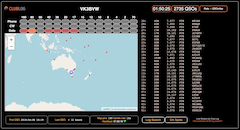
CLICK HERE for VK3BVW Live Stream (Clublog)
| QRZ callsign lookup: |
© Rob Wagner, Mount Evelyn DX Report, and contributors 2012-2026


Comments
Post a Comment
Comments are moderated and may not appear immediately. If your comment isn’t visible right away, it has been received and will be published shortly.